
Control Panel Manufacturer in Navi Mumbai- An In-Depth Guide to Solutions, Types, and Services
With Navi Mumbai rapidly emerging as a major industrial and manufacturing hub, the demand for industrial automation has grown significantly. At the core of this automation ecosystem are control panels, which act as the central nervous system of machines and processes by managing power distribution, monitoring operations, and ensuring safe, efficient performance. Widely used in manufacturing, process automation, and building infrastructure, control panels play a crucial role in achieving reliable and real-time control. Choosing the right Control Panel Manufacturer in Navi Mumbai is essential, as quality design, dependable components, and strong engineering directly impact safety, performance, and long-term productivity.
What are Industrial Control Panels ?
Industrial control panels are engineered electrical assemblies that house and manage components required to operate machines, motors, and automated systems. A typical industrial control panel is made up of switchgear, PLCs, MCCBs, relays, contactors, VFDs, power supplies, and indication devices. In unison, these control power distribution, machine logic, motor speed, safety interlocks, and monitoring functions. Control panels are used in several industries: manufacturing, pharmaceuticals, food processing, HVAC systems, water treatment plants, and building automation. They offer organized, safe, and reliable control over complicated electrical and automation processes for stable operation, troubleshooting, and maintenance.
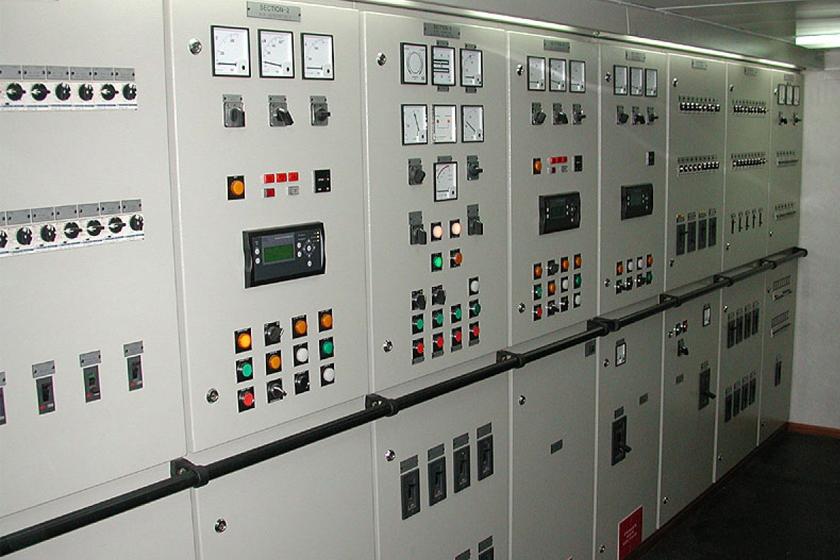
Types of Control Panels Offered in Navi Mumbai:
1. Power Control Panels (PCC, MCC, LT Panels)
Power command monitoring systems are the bone and sinews of the respective industrial electrical systems that safely distribute and manipulate the electrical power. The PCC (Power Control Center) takes care of the main incoming supply and is responsible for the stable power distribution across the plant. The MCC (Motor Control Center) panels are used to control several motors through starters, contactors, overload relays, and protection devices. LT panels take care of the low-tension distribution of power for different equipment. The construction of these panels gives full consideration to busbar systems, switchgear of the highest grades, and safety interlocks with the objectives of efficient load handling, minimal downtime, and maximum protection of the systems.
2. PLC Control Panels
PLC control panels are applied for the automation of machine and process control. They comprise the programmable logic controllers, I/O modules, relays, terminal blocks, and communication devices. This control panel takes care of complex control logic, machine functions, and accuracy refinement; thus, PLCs are the most basic equipment for industries that need repeatability, accuracy, interlocking, data logging, and remote monitoring. Hence PLC is the brain of the automated equipment, enhancing productivity by less human intervention and reducing operational errors.
3. VFD / Drive Panels
VFD drives control speed, and torque of the electric motors electronically. These controls are very important for conveyors, pumps, blowers, mixers, etc. By making motors adjustable in speed, VFD control panels save energy and facilitate enhanced process control, increased machine performance, and reduced mechanical stress on motors extending the life of the equipment. Integrated protection when required for a variable load condition.
4. The Benefits of APFC Panels
APFC panels, or Automatic Power Factor Correction panels, are used to maintain the proper power factor for industrial electrical installations, employing capacitor banks, contactors, and intelligent controllers. An undesirable power factor not only raises the electricity bill but also incurs penalties. The APFC panel thus switches capacitor banks on and off automatically with respect to load requirement so as to keep an optimal power factor. This will improve electrical efficiency, reduce transformer loading, and ultimately improve power quality in factories and commercial establishments.
5. Servo Control Panels
Servo control panels are for motion systems where precision control turns into servo drives or motors. These are one of the most important types of applications controlling, speed, position, and torque: CNC machines, robotics, packaging, printing, and automated assembly. The Servo panel consists of feedback systems, PLCs, safety circuits, and high-speed communications providing smooth motion control with utmost accuracy and excellent repeatability to meet advanced requirements in industrial automation.
6. Distribution Boards and Feeder Pillars
Distribution boards and feeder pillars provide safe distribution of electrical loads throughout industrial plants, workshops, commercial buildings, and outdoor installations. Containing MCBs, MCCBs, isolators, and protective devices arranged for convenient operation and maintenance, the boards protect the circuits from overloads and short circuits while providing a good supply to various services, lighting systems, machines, and utility equipment. Feeder pillars find wide application in street lighting and powering outdoor supply networks.
7. Customized Machine Control Panels
Customized control panels are meant to suit specific OEMs and for special-purpose machines. Concepts like PLCs, drives, relays, sensors, and safety devices are meshed according to a machine’s unique design. These panels are specially made to enhance machine performance, assure automation safety, and fulfill operating requirements. Custom panels add efficiency, endorse custom production processes, and facilitate easier integration to existing systems. They are suitable for packaging machines, material handling systems, test rigs, and fully automated production lines.
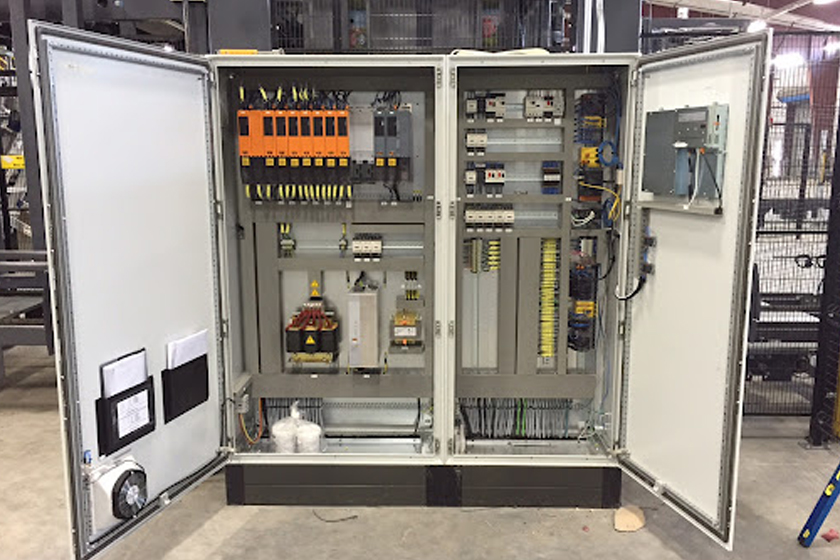
Step of the Control Panel Manufacturing Process:
1. Requirement Study & Load Analysis
The manufacturing process begins with complete comprehension of all client requirements, site conditions, machine or plant specifications. Engineers study total connected load, running load, motor ratings, control philosophy, and safety needs. Therefore load analysis, a method for determining cable sizing, busbar capacity, protection ratings, and overall panel design is done. This stage also ensures the control panel is capable of handling actual operating conditions, peak loads, and future expansion. Clear requirement study facilitates avoidance of design errors, increases efficiency, and ensures the design meets functional and safety standards.
2. Electrical Design & GA/SLD Preparation
After analysis, engineers then create the electrical design that includes the SLD (Single Line Diagram), control wiring drawings, and the communication layout. The GA (General Arrangement) drawings elucidate the dimensions of the panel, their internal layouts, the placement of components, and, last but not least, wiring routes. These ensure that the spacing, heat dissipation, accessibility for maintenance, and standards set forth in the electrical codes are all in order. A well-prepared design ensures that the panel runs smoothly, simplifies assembly, and has easy trouble-shooting for technicians and operators.
3. Component Selection & Panel Fabrication
Once the design is approved, high quality electrical components are selected based on various factors such as load, duty cycle, and environmental requirements. Select switchgear, PLCs, VFDs, relays, contactors, MCBs, and meters from trusted brands like Siemens, Schneider, ABB, or L&T. Panel fabrication involves cutting, bending, and assembling the enclosure using CRCA sheets or stainless steel. Proper painting, mounting plates, busbars, and ventilations arrangements are implemented. This is also the stage at which assurance is given that the panel is mechanically strong, durable, and applicable to both industrial and outdoor conditions.
4. Wiring & Testing and Quality Checks
The most skilled technicians only execute the wiring in accordance with the diagrams, which they do through the use of ferruled cables, proper routing, and optimum cable management. Control wiring, power wiring, and safety circuits are individually tested for continuity, insulation resistance, and for their phase identification. Every component, including interlocks, relays, PLC logic, and overload protections, is checked for correct functioning. High-voltage testing, earthing verification, and functional tests ensure operational reliability of the panels. According to stiff quality checks, the panel satisfies the requirement of safety and perfect working conditions.
5. FAT, SAT & Documentation
FAT is considered a Factory Acceptance Test, which will know how to conduct this test at the manufacturer’s premises in the client`s presence. All functions, logic sequences, alarms, and protections are demonstrated before dispatch. SAT is a site acceptance test that ensures that the panel works correctly with machines, motors, sensors, and field devices after being installed at the site. Final documentation comprises wiring diagrams, test reports, data sheets of components, and operation manuals, which will help operators to understand the system better for any future maintenance and compliance with industrial standards.
Conclusion
Control panels are indispensable in the modern industrial, commercial, and building automation systems with regards to safety power distribution, precise control of machines, and uninterrupted operations. Navi Mumbai, one of the crucial industrial hubs in the country for reliable and quality control panel manufacturing, rests on the foundations of skilled engineers, local expertise, and advanced automation capabilities. From PLC and VFD panels to customized machine panels, manufacturers in this region deliver reliable, efficient, and cost-effective solutions tailored to industry needs. Choosing the right control panel manufacturer helps ensure long-term performance, reduced downtime, and improved productivity. Therefore, one should think of appointing trusted and local manufacturers as smart and future-proof decisions in any automation or electrical requirements.